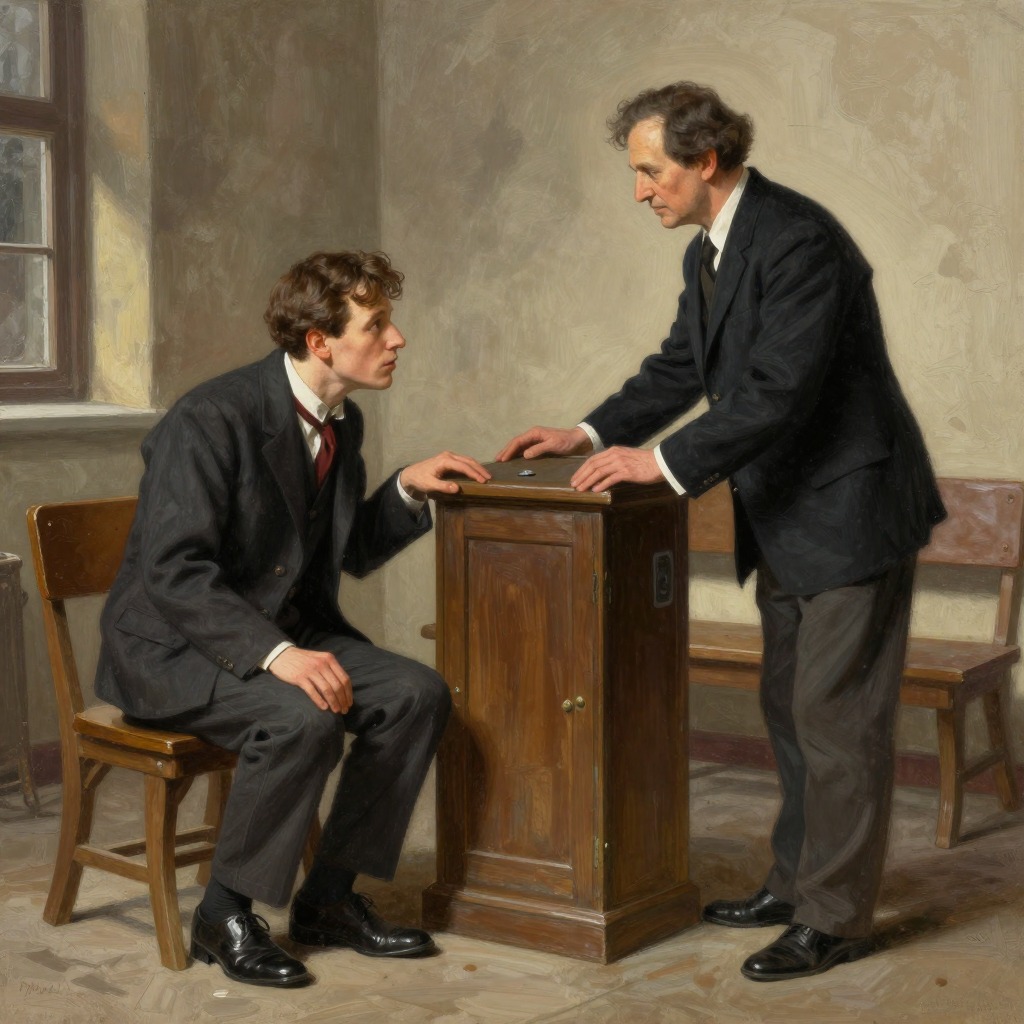
the teacher
The teacher is a small, narrow-shouldered young man who holds himself very upright, a posture that suggests his self-importance and his role as a figure of local authority. He is first seen by K. outside the village church, where he is surrounded by a crowd of children, all of whom are talking so fast that K. cannot understand them. The teacher, who has already noticed K. from a distance, greets him with a question about the castle, and when K. admits to being a stranger, the teacher remarks that strangers never like the castle. This brief exchange establishes the teacher's suspicion of outsiders and his alignment with the village's insularity. When K. asks if he may visit him, the teacher gives his address—Swan Alley, at the butcher's house—but does so in a manner that is more a statement than an invitation, reflecting his reluctance to engage with K. further.
Role as School Janitor and Superior
The teacher's most significant role in the novel comes when he delivers the village mayor's offer to K. of the temporary post of school janitor. The teacher makes it clear that he personally opposes the appointment, arguing that the school has never needed a janitor and that K.'s presence would only create more work and disorder. He lists the duties of the post—cleaning and heating the classrooms, making small repairs, clearing snow from the garden path, running errands for him and Miss Gisa, and doing all the gardening—and emphasizes that K. will receive no salary until after a month's probation. The teacher's manner is arrogant and condescending, and he treats K. with open disdain, referring to him as a 'millstone around our necks.' Despite this, K. accepts the post, largely at Frieda's urging, and the teacher becomes his immediate superior, a position he uses to humiliate K. at every opportunity.
Conflict and Humiliation at the School
The teacher's treatment of K. at the school is marked by a series of petty humiliations and conflicts. On the first morning, Miss Gisa, the assistant teacher, is furious to find K. and Frieda still in bed in the classroom, and the teacher himself later catches the assistants stealing firewood from the locked woodshed. When K. refuses to accept responsibility for the break-in, the teacher threatens to dismiss him on the spot, but K. insists that only the village mayor can dismiss him. The teacher then forces K. to fetch his lunch from the Bridge Inn and to tidy the room so that Miss Gisa can resume her lessons, all while treating K. with contempt. Despite these conflicts, K. remains in the post, partly because he hopes to use it as a means of gaining access to the castle, and partly because Frieda urges him to endure the humiliation for the sake of their future.
Relationship with K. and the Village Hierarchy
The teacher's relationship with K. is emblematic of the village's broader resistance to the outsider. He is a functionary of the village's bureaucratic system, answerable to the village mayor, and he enforces the rules with a rigidity that borders on cruelty. Yet he is also a figure of limited power, subordinate to the mayor and to the castle authorities, and his authority over K. is only provisional. The teacher's disdain for K. is rooted in his perception of K. as a disruptive and useless presence, and he makes no effort to hide his belief that K. is unfit for even the lowly post of school janitor. This conflict reflects the novel's larger themes of exclusion, bureaucracy, and the struggle for recognition in a world governed by opaque and arbitrary rules.
The Teacher's Role in the Bureaucratic Machinery
The teacher also serves as a conduit for the village's official communications. He is the one who draws up a memorandum of K.'s conversation with the village mayor, and he delivers the mayor's offer of the janitor's post. He is also present when K. is questioned by Momus, Klamm's village secretary, and he later reports to K. that the mayor has refused to accept his dismissal. In these roles, the teacher acts as a minor cog in the vast bureaucratic machinery that governs the village, and his interactions with K. reveal the extent to which the village's authority is both arbitrary and self-perpetuating. The teacher's own position is precarious—he is dependent on the mayor's goodwill, and he must defer to the castle's officials—yet he exercises his limited power over K. with a petty tyranny that mirrors the larger structures of control.